


[ad_1]
By Olusegun Adeniyi
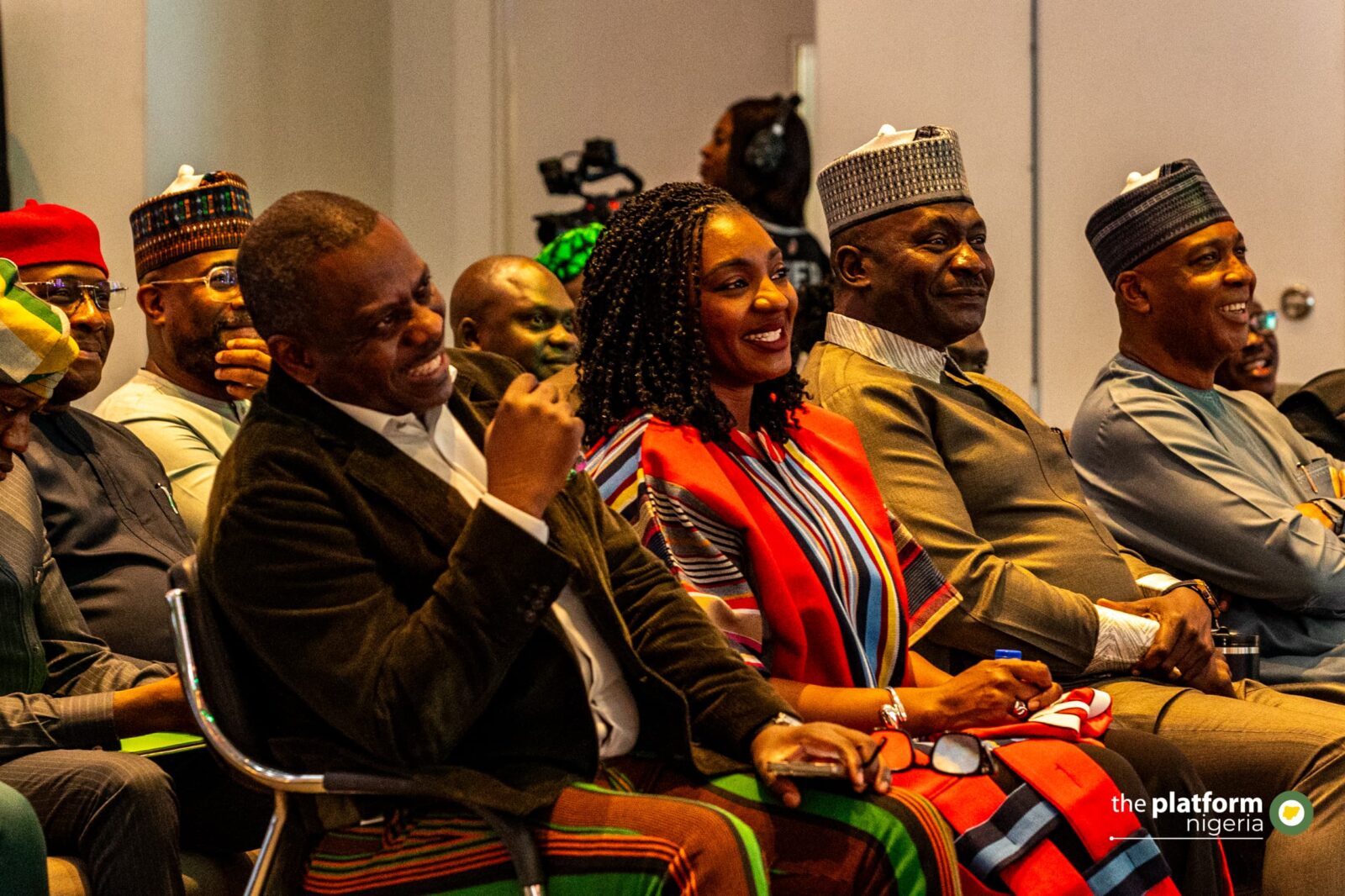
(Text of my presentation at the 2026 edition of ‘Platform Nigeria’ organised by Senior Pastor of the Covenant Nation, Pastor Poju Oyemade, in Lagos on June 12)
Distinguished ladies and gentlemen. Before I go to the substance of my presentation, I want to briefly report how Pastor Poju has tormented my life for many years. But most especially in the last 13 months. It all started on 26 May 2025 when he sent me the English premier league tables for 2022/2023, 2023/2024 and 2024/2025 seasons where Arsenal came second on all occasions. Pastor Poju then added this caption: ‘Official: Arsenal have completed a treble.’ A month later on 20 June, he forwarded a poster with the inscription: ‘Premier league should resume fast. I saw some Arsenal fans laughing yesterday.’
With Liverpool spending a record £446 million in the 2025 summer transfer window, including a British record £125 million Deadline Day deal for Alexander Isak, just after winning the premiership, the harassment between June and September last year was indescribable. Of course, most of the messages dwelt on how Liverpool would stroll to the 2025/2026 premiership title. For instance, on 21 September, Pastor Poju forwarded to me the league table with a crisp message: ‘Liverpool now 5 points clear.’ But since God pass man, as they say on the street, Liverpool lost two matches in quick succession. Then Pastor Poju suddenly remembered his calling. Here goes his message of 4 October 2025: ‘Micah 7: 8: Rejoice not against me, o mine enemy. When I fall, I shall arise; when I sit in darkness, the Lord shall be a light unto me’. After that Bible passage, Pastor Poju then added a line: ‘I felt I should drop this here.’
To be fair, this was by no means a one-way harassment. On 27 November last year, with Liverpool losing one match after another, I forwarded the cartoon of a man inside a pharmacy with the attendant saying, “I am sorry Sir, but to get anti-depressant pills, you need a proper prescription. Simply showing your Liverpool season ticket is not enough.” But Pastor Poju got his revenge on 26 January this year after Manchester United secured their lucky break at the Emirates. He forwarded a message that had this dialogue: “Someone asked me, ‘why do football players earn more than doctors?’ I replied: ‘Can a doctor save 8 billion people in 3 seconds?’ He said No. I said, ‘well, Cunha did it in the EPL against Arsenal. He saved the world from noise pollution and now everywhere is quiet.’
From the moment Arsenal lost the Carabao Cup final on 23 March to the serial defeats in April that saw Manchester City momentarily sitting atop the league table, Pastor Poju was brutal in his messages. But then, on 11th May after the nail-biting win over West Ham that put Arsenal on the verge of winning the premiership, I also forwarded to him this message: “Before the 83rd minute, I was hit by anxiety. After that goal, I cried. After the equaliser, I had a heart attack. After the win, I was celebrating inside the ambulance. Right now, I am driving the ambulance driver to the hospital because he had a heart attack too. He is a Manchester City supporter.’
I could have said that imaginary driver is a Liverpool supporter. But then. I am a generous man…
Distinguished ladies and gentlemen, I have shared all this not only to entertain, but also because that exchange with Pastor Poju captures something I find genuinely instructive. Here is a very busy man who shepherds a big flock and has spent the last two decades building ‘Platform Nigeria’ into one of the most consequential intellectual and civic spaces on this continent. Yet he found time, week after week, to torment an Arsenal supporter with league tables, Bible verses, posters and cartoons. That says something about Pastor Poju. Whether he is curating a conversation about Nigeria’s future or sending me a meme about football at midnight, the man is fully present. But there is even a bigger issue here.
Pastor Poju and I do not support the same football club. We probably never will, unless he wants to be a Gunner. But across one premiership league season of rivalry, not once did either of us walk away from the conversation. We sharpened each other, made each other laugh, and kept faith with the idea that the other person, however misguided about their football team, was worth engaging. That is the disposition that nation-building demands, and precisely what this platform has modelled for us, year after year. Platform Nigeria was built on a simple but radical premise that Nigerians of different persuasions, generations, and convictions could sit in the same room, disagree sharply, and still leave richer for the encounter.
The lesson from football is that rivalry, when it is honest and accompanied by mutual respect, deepens relationships. Liverpool and Arsenal supporters may never see eye to eye. But they share a language, passion, and common investment in something larger than themselves. That is the wager of Platform Nigeria, that our differences, far from being liabilities, are the very raw material from which a serious nation can be forged, if only we have the courage and the courtesy to keep talking. What Pastor Poju has created here is not a venue for consensus. It is a venue for encounter. And Nigeria owes him a debt of gratitude for it.
For the record, this is my 9th time speaking on ‘Platform Nigeria’. And I cannot but thank Mrs Toyin Oyemade who I understand influences my being invited again and again because she enjoys my cow stories. Unfortunately, I have no cow tales to share today. But in the few minutes I have left I would like to talk briefly about a haunting silence spreading across democracies. It is the silence of citizens turning their backs on the very process meant to give them voice. And nowhere does this echo more ominously than in Nigeria.
The 2023 presidential election recorded a voter turnout of just 26.72 percent, the lowest in Nigeria’s electoral history. Out of 93.47 million registered voters, only 24.9 million showed up to vote. More starkly still, the mandate of the winning candidate on which an anthem has been invented, flows from less than 10 percent of Nigeria’s electorate. The numbers indeed tell a story of progressive deterioration.
In 2003, the high-water mark of our post-military participatory energy, Nigeria recorded 69 percent turnout. By 2011, it had fallen to 53.7 percent. In 2015, it dropped further to 43.7 percent. Then to 34.75 percent in 2019. And three years ago, 26.72 percent. The trajectory is unmistakable. With each election cycle, more Nigerians are choosing not to choose. Meanwhile, this problem is associated with all our elections and not just the presidential. For instance, the last Ondo State Gubernatorial election in 2024 recorded a voter turn out of just 25 percent.
Yes, our politicians have been quick to celebrate their victories, and issue acceptance speeches about mandates and democratic legitimacy. But there is a question they must now confront: What does it mean to govern with the consent of so few? Each election cycle, we witness the familiar theatre, rallies packed with “supporters” whose transport and feeding have been arranged, town halls filled with party faithful who were mobilized, and on election day itself, what we are inundated with are reports of voters being cajoled, induced, or in some cases, coerced to polling units.
To understand the magnitude of our crisis, let’s consider the global context. The University of Essex in the United Kingdom conducted what researchers described as the most extensive cross-national study of voter turnout to date, analysing all post-1945 democratic elections across 116 countries. Their finding was unambiguous: global average turnout has dropped from above 77 percent in the late 1960s to below 67 percent after 2010.
The findings from that research published in the journal, World Politics, deserve to be read slowly: “As democracy has expanded across countries, electoral participation has declined.” But even in countries facing democratic challenges, participation remains substantially higher than ours. The Organisation for Economic Co-operation and Development (OECD) average stands at 65 percent. average stands at 65 percent. Nigeria’s 27 percent represents the worst turnout in Africa.
The standard explanations for low turnout of voters are logistical failures, insecurity, distance to polling units, restrictions of movement on election day, and voter suppression. Yes, insufficient voter education, fear of violence, inadequate understanding of the electoral process and orchestrated mischief to keep voters away all play roles. But at its core, Nigeria’s voter apathy crisis is about trust, or rather, the catastrophic erosion of trust. Therefore, the uncomfortable truth our political class must face is this: The democracy we practice does not impact enough Nigerians to make them care about voting.
Following the Abuja Municipal Area Council (AMAC) election in February this year, I wrote a column, ‘In Defence of Abuja’s (Non)Voters’ which resonated with many people. With 65,676 votes recorded for all the candidates, out of 837,338 registered voters, it meant that just about 8 percent of AMAC residents who registered to vote bothered to exercise their franchise. In that intervention, I warned that nobody should downplay the challenge of voter apathy and the dire implications of a pervasive lack of interest to participate in our elections. From disillusionment with the performance of public officials to the growing perception that their votes may not count, there are justifiable reasons why many Nigerians are staying away from the polling booth at election time. And such electoral indifference bodes ill for our democracy.
The Centre for Democracy and Development (CDD) has identified trust and turnout as the biggest stories of the 2023 elections. Citizens no longer trust that their votes will count or most devastatingly, that it matters who wins, according to CDD. What should terrify our political class is that when three-quarters of registered voters see no point in participating, we do not have a democracy in any meaningful sense. This deliberate disengagement impacts not just electoral outcomes but also the entire system. In a research paper, ‘Voter Turnout Problems: Government by SOME of the People’, Douglas J. Amy, a Professor Emeritus of Politics at Mount Holyoke College in the United States, contends that low turnout undermines majority rule, fair representation and policy responsiveness which are key aspects of a democracy.
At this point, it may be important to say that low turnout of voters based on public dissatisfaction with the ruling class is not peculiar to Nigeria. On 1st November 2021 in South Africa, the people of Phungulelweni community shut down the voting station in Ward 13 of Ntabankulu Local Municipality in protest over lack of access to drinking water and bad roads. The people said it was no longer worth their trouble to vote because elected public officials don’t care about them.
At the end, from 55% voters’ turnout in 2016 in the municipality, only 2% voted in 2021! Two years later, in December 2023, a survey on voter-behaviour in the country was released by the Human Science Research Council (HRSC). In one of their findings, young South Africans say they boycott elections because they believe that voting makes no difference in their material condition.
This may be the time to also interrogate why registered voters in Nigeria are losing interest in voting. Not with the aim of devising better mobilization strategies or more effective inducements, but with genuine curiosity about why citizens have concluded that their participation does not matter. I must admit that increased voter turnout cannot in and of itself guarantee a people-friendly government. But to restore voter confidence and participation, Nigerians must begin to see that those elected to public offices work for them. Because eventually, perhaps sooner than we think, this mass disengagement will have consequences.
Distinguished ladies and gentlemen, there is no way we can talk about turn out of voters without highlighting the wonders of Nigerian political environment. The low voter turnout that we witness in our general elections conducted by the Independent National Electoral Commission (INEC) is never reflected in the primaries of the political parties. The ruling All Progressives Congress (APC) and the leading opposition African Democratic Congress (ADC) recently conducted their primaries in preparation for the 2027 general election.
From a membership register of 12,643,316, APC was able to record 11,069,756 votes, which represents 87.5% turn out while from a register of 3,113,599 members, 2,527,977 voters were also accredited for the ADC, representing a turnout of 81.2%. But we all know what is going on. Or don’t we?
Let me also use this opportunity to express my disappointment with the current opposition in our country whose members are busy tearing one another apart on social media. I am sure many Nigerians are aware that come next week Saturday, a gubernatorial election will hold in Ekiti State. What many may be unaware of is that there will also be six bye-elections on that same day: Four Senatorial elections with one each in Ondo, Rivers, Nasarawa and Enugu. There will also be a House of Assembly election in Kebbi and a House of Representatives election in Kano. Now, here is the issue. The last day for parties to submit their membership registers to INEC was 10 May 2026. Primaries for the bye-elections were conducted almost two weeks later from 22 to 26 May, according to the timetable published by the commission. Yet, the ADC and NDC are not fielding candidates in any of these bye-elections holding next week in five geopolitical zones in the country! If those who seek to displace the people in power do not even have the presence of mind to put their members on the ballot in crucial elections, what then is the guarantee that they would be different if they get to government?
Distinguished ladies and gentlemen. Now, let me speak to those who would say, ‘my vote is just one, what does it matter if I vote or not?’ Well, history teaches that every vote matters. From the Dakota Legislative District 12 election in the United States to that of an Exeter Member of Parliament in the UK to the Zanzibar district of Chake-Chake, dozens of crucial elections have been decided by a single vote. But perhaps the most interesting case happened in an Indian legislative election in Rajasthan State in 2008. According to the declared result, C. P. Joshi secured 62,215 votes while his victorious opponent, Kalyan Singh Chouhan, got 62,216 votes. But here is the real story: While the wife, mother, and personal driver of the defeated Joshi reportedly failed to vote, Chouchan’s wife was said to have voted at two different polling stations. Someone must conduct a DNA test on that woman to ascertain where she truly comes from!
The essence of those examples is to disprove the notion that one vote cannot make a significant difference. In 2016, the MIT Election Lab did a report which revealed that between 1976 and 2021, hundreds of key elections in the United States were decided by just a handful of votes. In Nigeria, we have also seen a number of close electoral contests. In 2019, for instance, then incumbent Governor Aminu Tambuwal secured a second term in Sokoto State by a margin of 342 votes which is just the size of an average polling unit. So, by refusing to vote, you are also indirectly making a choice because you are ceding to other people the responsibility to decide who governs you.
As an aside, as I speak, several schoolchildren and their teachers, seized from their classrooms in some communities in Oyo State about a month agio remain in the hands of their captors somewhere in the forest. One of those teachers, Michael Oyedokun, will not be coming home; his abductors beheaded him. Dozens of Borno State school children are also in captivity. I am not sure that the Democracy Day we commemorate today would mean anything to the families of those victims and thousands of others across the country who are currently negotiating ransom for the release of their loved ones. As we all pray for the quick release of those victims, we can only hope that authorities in the country will find a lasting solution to the growing security challenge.
Distinguished ladies and gentlemen, the import of the foregoing is that democracy, for all its flaws and frustrations, remains the only system that gives ordinary citizens a say in who governs them. The right to make that choice is therefore not a gift granted by politicians. It is one of the hardest-won freedoms in human history. Generations of Nigerians fought, marched, bled, and died to establish the principle that the people would determine who sits in Aso Rock, state government houses and in all the legislative chambers whether they are green or red. That is the essence of the Democracy Day that we celebrate today. President Bola Tinubu captured that very well in his broadcast this morning.
Therefore, to abandon that obligation is to ignore the sacrifices of so many compatriots with unintended consequences. Indeed, the same Essex study earlier referenced reveals that low voter turnout leads to socio-economically distorted participation, biased public policies, and fertile ground for clientelism and patronage politics that drove people away in the first place. In other words, low turnout and broken government feed each other in an accelerating spiral.
The beauty of democracy is not that it produces perfect leaders. Its beauty is that it gives citizens a mechanism to remove imperfect ones. That mechanism only works if the citizens use it. Therefore, as we approach the 2027 general election, the choice before Nigerians is stark. We can continue to celebrate ever-narrower ‘victories’ based on the votes of an ever-shrinking fraction of the electorate. Or we can acknowledge that we are in a crisis by doing the difficult work of rebuilding trust, making elections credible and delivering on tangible improvements in the lives of ordinary Nigerians.
This then brings me to the story of a lawmaker seeking re-election as a member of his state House of Assembly. While on a campaign tour in a poor community within his constituency, he asked people in the crowd to name their two most pressing problems. The first man he called said the roof of the primary school in the community had been blown away by rain. “That should not be a problem,” the lawmaker replied. “I know the governor is devoting a lot of money to education in the supplementary budget that will be sent to the House next week,” he added as he brought out his phone for a long conversation with someone the crowd suspected could only be the governor. Especially when the Honourable member ended the conversation with ‘Thank you very much, Your Excellency’. He then explained to the people that the governor has assured him that he would construct a new primary school for the community. “Now what is the next pressing problem?” he asked. A young man was called and he said: “We hope you can help us so that we can also be making calls like you. There’s no mobile network coverage in this village.”
Pastor Poju, distinguished ladies and gentlemen, for me, the question is not whether Nigerians want to vote. The registration numbers prove they do. The question is whether they believe their votes matter. And until we can answer that question affirmatively, and citizens can see a clear line between their ballot and a better life, the silence at the polls will only grow louder. Yet, history shows that when people give up on the ballot, they find other ways to make their voices heard. And those ways are rarely peaceful or orderly.
Thank you very much for listening and Happy Democracy Day!
·
[ad_2]
Source link













Leave a comment