


[ad_1]
Despite sustained interventions, maternal mortality remains high in Lagos, driven partly by pregnant women switching hospitals during pregnancy, which disrupts continuity of care. Omolabake Fasogbon reports on how Digital Public Infrastructure—through shared digital identity, interoperable health records, and a connected referral system—could help close deadly gaps in maternal healthcare
In September 2025, a viral case surfaced online involving an unidentified woman in Abuja who lost her pregnancy after delays caused by obtaining a referral letter from the facility where she registered for antenatal care, finding a N28,000 deposit and being transferred between hospitals, all while in labour.
This journey took time she did not have. By the time the delay resolved itself, her twins were dead. The case went viral on TikTok, as shared by a user identified as Ondeku Joy and cited by Nigeria Health Watch. In the comments, hundreds of women said they recognised the system. They had navigated it themselves.
Earlier that same year, another widely reported case involved late Kemi Folajimi, who died from pregnancy complications at a hospital where she was not registered for antenatal care. Kemi, it was learnt, had registered with a local midwife in her community, where her medical records and history remained.
While her husband, Akinbobola Folajimi, claimed she was denied treatment over a failure to deposit N500,000 upfront, the founder of the hospital where she died, Dr. Rauf Salami, later said her condition was already critical and, as an unbooked patient, needed referral to a better-equipped facility. She never got there, she died.
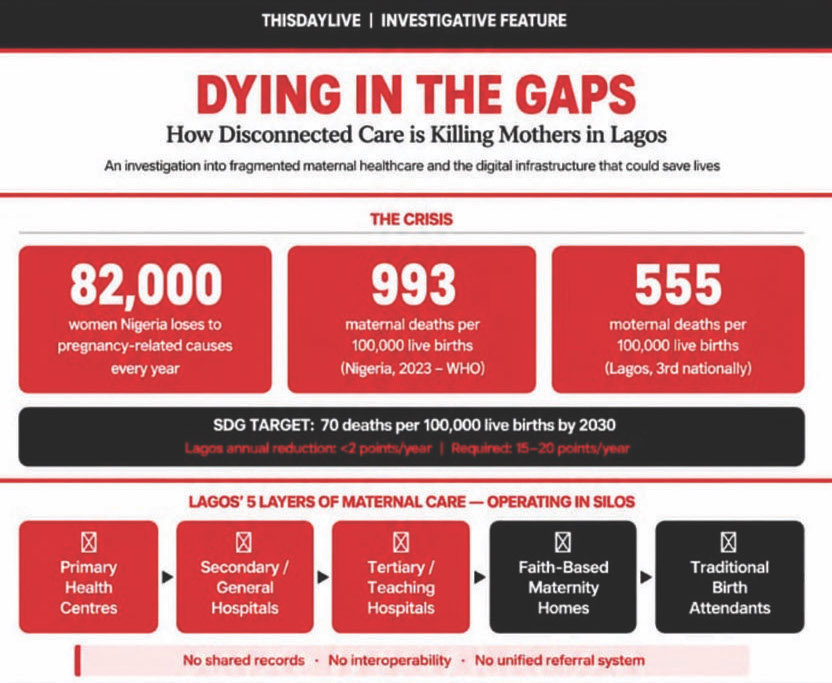
Kemi was one of an estimated 82,000 women Nigeria loses to pregnancy-related causes every year. Many of them, experts say, did not die because their complications were untreatable, but from care discontinuity, broken referral and missing records.
The victims’ ordeals reflect the growing reality of pregnant women switching healthcare facilities during pregnancy, and in a system ill-equipped to handle such transitions.
Reports show a high prevalence of pregnant women failing to complete care at a single facility, often resulting in neonate or fetal loss, or maternal death, as above. This casualty rate is further fuelled by fragmented medical records, poor healthcare system interoperability, and the lack of a unique patient identification system. These challenges mirror the current reality in Lagos, where a Digital Public Infrastructure (DPI) solution is deemed urgent to bridge the gap.
In the former case, medical experts noted that a hard -copy referral letter from the booked hospital to access the pregnant woman’s history would have been unnecessary had interoperable Electronic Patient Records (EPRs) existed, like those used in the United Kingdom, potentially preventing the delay that cost her twins’ lives. In Lagos, EPRs are available but are not interoperable.
Why Continuity Matters
As outlined at the 2005 Partnership for Maternal, Newborn and Child Health meeting hosted by the World Health Organisation (WHO) in Geneva, continuity of care refers to integrated service delivery for mothers and children from pre-pregnancy through delivery, the immediate postnatal period, and childhood.
WHO emphasises that care must be integrated, and that continuity should exist across the providers and facilities a patient encounters during pregnancy. Referrals and follow-up should also be linked.
In “Holding the Line: Maintaining Continuity of Care for Patient Safety,” published on the blog of Canada-based healthcare consulting firm Courtemanche & Associates, healthcare consultant, Christopher Pratt explained why continuity of care cannot be neglected, especially in complex systems.
According to him, continuity of care is crucial for patient safety because it builds trust, keeps providers aware of patient needs and vulnerabilities, and helps coordinate treatment, thereby reducing fragmented care, medical errors and avoidable readmissions through stronger communication and information sharing.
“Ultimately, maintaining continuity of care reduces adverse safety events and improves patient outcomes,” he stated.
The World Bank estimates that 74 percent of maternal deaths could be averted if all women had access to timely interventions, including referral services for pregnancy or childbirth complications.
Lived Reality
Beyond the viral cases, many women in Lagos say navigating maternal healthcare often means moving between multiple providers, formal and informal care systems, sometimes in the middle of emergencies.
Mariam Olaniyi, a mother living in Bariga, Lagos, said she experienced the consequences of fractured care firsthand.
“When my pregnancy reached five months, we relocated to a more distant place. A neighbour then introduced me to a nearby faith-based maternity homes where women were cared for with prayers, so I stopped going to the clinic. “But during labour, complications started. The mission home panicked and told my husband to rush me to the General Hospital. By the time we arrived, I was bleeding heavily and had no medical notes explaining my condition, doctors had to run fresh tests while my husband searched for a new folder to open a file,” she said.
The faith-based maternity home is one of the maternal healthcare providers in the state’s mapped system, which if integrated with other four, including where Mariam had sought emergency service, would possibly have saved his baby boy.
“I narrowly survived, but I lost my baby boy,” she recounted.
Mariam’s story is not unusual. Available data confirm it.
Dying Despite the Interventions
Maternal deaths remain a major public health threat across Nigeria, with consequences that transcend national and state indices. The burden extends beyond the affected women-families, friends, communities, and well-wishers often share in the grief and trauma.
According to World Health Organisation (WHO) data, Nigeria has one of the highest maternal mortality rate globally, with an estimated ratio of 993 deaths per 100,000 live births as of 2023 nearly 15 times higher than the Sustainable Development Goal (SDG) benchmark of 70 per 100,000 live births.
In Lagos, the situation remains troubling despite interventions that include strengthening and upgrade of 47 Primary Health Centres (PHCs), the Maternal and Child Mortality Reduction (MCMR) Programme, donor-funded schemes and other NGO-backed initiatives.
With a mortality rate of 555 per 100,000 live births, Lagos ranks third in maternal and infant deaths nationally. The Special Adviser to the Governor on Health, Dr. Kemi Ogunyemi further attributed scourge to a shortage of healthcare workers, noting that the state is now considering a task-shifting policy alongside the retraining of community health extension workers.
Similarly, the Permanent Secretary of Lagos State Health District V, Dr. Oladapo Asiyanbi, noted at a stakeholders gathering in Lagos that while maternal deaths are declining, the pace is far behind global targets.
According to Asiyanbi, the expected annual reduction benchmark is between 15 and 20 points, Lagos is recording less than a two-point reduction yearly, highlighting gaps requiring attention.
This slow pace of progress despite multiple interventions has continued to raise concerns about effectiveness of interventions and resources devoted to the cause.
Speaking at a high-level stakeholder sensitization meeting, the state Commissioner for Health, Prof. Akin Abayomi admitted Lagos’ maternal mortality record remains unacceptable relative to its global profile.
Abayomi noted that the state has mapped five layers of maternal healthcare providers: Primary Healthcare Centres (PHCs), secondary/general hospitals, tertiary/specialist teaching hospitals, faith-based maternity homes and Traditional Birth Attendants (TBAs), which it is working to integrate into the formal health system.
While these multiple layers provide women with wider options for antenatal care and delivery as aligned with their convictions, experts say stronger synergy is crucial, amid growing movement of patients across multiple facilities. This will enhance continuity of care, making patient information follow them anywhere. This coordination, however, remains visibly lacking in the state, contributing to preventable deaths.
Inside the Lagos Silos
The Executive Director of MRHCollective, Olajumoke Oke raised concerns over the wide gap between the number of women attending antenatal care and those delivering in health facilities in Lagos.
Speaking at a recent meeting to strengthen maternal health systems in Lagos, Oke explained that while distance, staff attitudes, cost, quality of care, spiritual beliefs, and emergency referral issues drive this trend, she warned siloed operations among delivery facilities are aggravating associated risks.
Studies across individual hospitals in the state further corroborate her concerns, pointing to fragmented maternal healthcare interventions, with one of the hospitals, Orile Agege General Hospital, Ile-Epo quantifying care fragmentation at 88.2 per cent.
Stakeholders at the meeting also highlighted broken operations among relevant agencies and maternal healthcare providers, causing isolated interventions that lack depth and do not always reflect the realities or needs of patients.
Oke stated, “The number of women attending antenatal care is nowhere near the number delivering in health facilities, yet many still return for immunization afterward.
“That tells us these women are accessing care at some points but dropping out at critical stages, particularly during delivery. The same disconnect exists between antenatal care and family planning services. This underscores the need to harmonise the continuum of care from antenatal care to delivery, immunisation, and family planning.”
She asserted that stronger collaboration, improved data systems, and community engagement are critical to closing these gaps across the state.
A midwife at a public hospital who asked not to be named because she was not authorised to speak publicly described the daily reality of receiving women whose histories are unknown.
“They come in, and you ask, ‘ Where have you been attending? They mention one private hospital, or a midwife around them. And we have nothing. No file, no record, no blood group sometimes, we are starting from zero while the woman is in pain in front of you.” She said the problem is worse during emergencies.
“When a referral comes in at night, sometimes all we get is a note on a piece of paper. Sometimes we get nothing. You just do your best with what you can see.”
The Founder and Chairperson of the MRH Research Collective, Prof. Bosede Afolabi maintained that maternal mortality remains a complex issue that cannot be solved through isolated interventions.
Afolabi, who is also a Professor of Obstetrics and Gynecology at the College of Medicine, University of Lagos, urged strong collaboration to tackle the challenge, identifying referral systems, health insurance, respectful maternity care, and healthcare facility preservation as areas requiring urgent coordination.
Unique Maternal Digital IDs: Backbone of DPI Rollout
Medical stakeholders have increasingly advocated digital interventions to address fragmented maternal healthcare in Lagos, with experts now urging a Digital Public Infrastructure (DPI) approach built around continuity, interoperability and coordinated care.
DPI, a set of shared interoperable systems built on open standards, enables integration across multiple healthcare layers. While Lagos has made strides in digitising parts of its health sector through electronic medical records, experts say the next step is interoperability across facilities and providers.
Drawing lessons from India’s digital identity architecture and the UK’s integrated care systems, digital public health expert in Digital Innovations in Health and Social Care, Dr Zaid Olanrewaju, proposed a minimum interoperability framework built on three pillars: a unique maternal digital identity, interoperable longitudinal health records, and a statewide referral and notification system.
Under such a framework, he explained, “Every pregnant woman would have a single identifier linked to her journey across facilities, while hospitals and PHCs exchange records through standards like HL7 Fast Healthcare Interoperability Resource (FHIR).”- a modern standard for secure, web-based data exchange through APIs.
Founder of Health Drive Nigeria, Dr. Adewunmi Akingbola similarly advocated for a federated health information exchange that would allow Lagos’ six health districts to retain their local databases while synchronising core maternal health data into a shared state platform for referrals, planning and emergency coordination. Akingbola advised shifting from institution-centred care to a connected ecosystem.
Under such a connected system, Akingbola explained that “Hospitals, PHCs, NGOs, labs, and community health workers would plug into one network with common standards for referrals, patient records and reporting”. He noted that real-time tracking and risk alerts could eliminate duplicated assessments and the common issue of women disappearing between stages of care.
“If a woman is identified as high-risk, the system can automatically trigger referrals and monitor her arrival. This visibility shifts care from isolated interventions to a coordinated system,” Akingbola stated.
To improve emergency response, Olanrewaju proposed a “command-and-control” referral model. This real-time network would connect ambulances and hospitals, allowing providers to view bed availability and escalation pathways, reducing the delays that drive maternal mortality.
Because technology alone cannot cure community distrust, both experts thus advocated formal integration of licensed TBAs into referral systems, citing their cultural alignment, accessibility and trust within communities.
Akingbola recommended equipping TBAs with simple USSD and WhatsApp-based reporting tools rather than app-dependent systems to eliminate digital literacy barriers.
He also advised incentivising TBAs based on early pregnancy registration, successful referrals and completed maternal care journeys, effectively transforming them from independent providers into trusted community navigators.
The experts concluded by cautioning administrators against large-scale tech rollouts without first mapping existing referral pathways.
“Lagos should prioritize the foundations of coordination before investing in new technology. Reducing maternal mortality depends less on building more apps and more on creating a connected ecosystem where every provider contributes to one continuous care pathway, “they submitted.
For many women in Lagos, experts maintain that safe childbirth depends on how quickly care can be connected between one provider and another.
Kemi Folajimi did not survive, nor did the fetuses. Both paid with their lives for gaps that a connected system could have closed. Those gaps remain open. Whether Lagos bridges them will determine if the next Kemi survives.
[ad_2]
Source link














Leave a comment