


[ad_1]
The Nigerian Navy has concluded a week-long celebration marking its 70th anniversary, providing an opportunity to reflect on its remarkable transformation from a modest coastal force of 11 patrol boats into one of Africa’s largest naval forces with over 150 active vessels and platforms. Through a series of events, including international engagements, community outreach programmes, the Seapower for Africa Symposium, the inauguration of the Combined Maritime Task Force, the International Fleet Review and the Ceremonial Sunset, the Navy showcased its operational achievements, expanding capabilities and unwavering commitment to maritime security. The celebrations also highlighted optimism for the future under the leadership of the Chief of Naval Staff, Vice Admiral Idi Abbas, whose vision is anchored on modernisation, regional cooperation, technological innovation and a stronger role for the Navy in protecting Nigeria’s maritime interests and supporting national development. Chiemelie Ezeobi reports
From a modest beginning as a small maritime force equipped with a handful of vessels, the Nigerian Navy has grown into one of Africa’s most capable and respected naval services. Over the past seven decades, it has transformed from a coastal defence outfit into a modern, multi-mission force playing a critical role in safeguarding Nigeria’s maritime domain, protecting national economic interests, supporting regional security, and contributing to international maritime cooperation.
Humble Beginnings
Although the Nigerian Navy started from humble beginnings, the service has come a long way from its origins as the colonial Marine Department of the Royal Navy, which operated only a few coastal boats. Today, it has evolved into one of the leading navies not only in the West African subregion but also in the Gulf of Guinea (GoG) and across sub-Saharan Africa as the largest naval force in Africa with over 150 active vessels and platforms.
The origin of the Nigerian Navy can be traced to the Colonial Marine Department of the Royal Navy, established in 1887 as a quasi-military organisation. The department combined the responsibilities now performed by the Nigerian Ports Authority, the Inland Waterways authorities and the modern Nigerian Navy until the end of the Second World War in 1945.
In 1956, a government policy statement led to the establishment of the Nigerian Naval Force. On June 1, 1956, the Nigerian Naval Defence Force (NNDF) commenced operations with 11 assorted ships and craft, comprising two survey vessels, Petrel and Pathfinder; two training boats, Dignity and Nymph; one patrol craft, Challenger; three VIP boats, Valiant and Frances with her launch; one tug, Trojan; and one general purpose launch, Jade.
On August 1, 1956, the first naval legislation was passed by the House of Representatives and received assent on September 5, 1956, from Sir James Robertson, the Governor General. The Nigerian Navy Ordinance subsequently led to the designation of the NNDF as the Royal Nigerian Navy.
In 1963, when Nigeria became a republic, the prefix “Royal” was dropped and the service became known as the Nigerian Navy. However, the Ordinance that established the Navy had several limitations, the principal one being the restriction that confined naval operations to only three nautical miles, which at the time represented the country’s territorial waters.
These shortcomings were addressed by the post-independence Navy Act of 1964. The Act removed the principal limitation on the Navy’s operations within Nigeria’s territorial waters. Although the Navy possessed only a handful of patrol boats during its formative years, it has since grown into a formidable multi-mission maritime arm of the Armed Forces of Nigeria, undertaking a wide range of wartime and peacetime responsibilities.
Roles and Responsibilities
In accordance with the 1999 Constitution of the Federal Republic of Nigeria and the Armed Forces Act, Cap A20, the Nigerian Navy is charged with the defence of Nigeria’s territorial integrity at sea. Its responsibilities span the full spectrum of military, policing and diplomatic functions.
These roles include enforcing and assisting in the enforcement of customs, immigration, anti-bunkering, fisheries protection and pollution control laws, as well as implementing national and international maritime laws to which Nigeria is a signatory. The Armed Forces Act further empowers the Navy to coordinate the enforcement of all national and international maritime laws acceded to by Nigeria.
Other statutory responsibilities include the production of nautical charts, coordination of national hydrographic surveys, and the promotion, coordination and enforcement of maritime safety regulations within Nigeria’s territorial waters and Exclusive Economic Zone (EEZ).
Past Icons of the Navy
Often referred to as Icons of the Navy, the Chiefs of the Naval Staff since inception include Captain F.W. Skutil, who served as CNS from 1956 to 1958, and Commodore A.R. Kennedy, who held the helm of affairs from 1958 to 1964. Others were Vice Admiral J.E.A. Wey from 1964 to 1973; Vice Admiral N.B. Soroh from 1973 to 1975; and Vice Admiral M.A. Adelanwa from 1975 to 1980.
Not left out are Vice Admiral A.A. Aduwo, who served from 1980 to 1983; Vice Admiral A.A. Aikhomu from 1984 to 1986; Vice Admiral Patrick Koshoni from 1986 to 1990; Vice Admiral Murtala Nyako from 1990 to 1992; Vice Admiral D.P.E. Omatsola from 1992 to 1993; and Rear Admiral S. Sa’idu, who was appointed in 1993 and removed the same year.
Others after him include Rear Admiral A.A. Madueke from 1993 to 1994; Rear Admiral O.M. Akhigbe from 1994 to 1998; Vice Admiral J. Ayinla from 1998 to 1999; Vice Admiral V.K. Ombu from 1999 to 2001; Vice Admiral S.O. Afolayan from 2001 to 2005; Vice Admiral G.T.A. Adekeye from 2005 to 2008; and Vice Admiral I.I. Ibrahim from 2008 to 2010. I.I. Ibrahim was succeeded by Vice Admiral O.S. Ibrahim, who served from 2010 to 2012. Vice Admiral D.J. Ezeoba took over in 2012 and handed over to Vice Admiral Usman Jibrin in 2013. In 2015, Vice Admiral Ibok Ete Ibas took over as the 20th Chief of the Naval Staff and handed over to Vice Admiral A.Z. Gambo in 2021, who handed over to Vice Admiral Ikechukwu Emmanuel Ogalla in 2023, who in turn handed over to the current CNS, Vice Admiral Idi Abbas in 2025.
Platinum Jubilee
As expected, the platinum jubilee celebrations of the Nigerian Navy featured a packed itinerary from May 21 to June 4, 2026, showcasing the service’s operational achievements, international partnerships, and commitment to national development.
The anniversary programme was structured around community outreach activities, naval engagements, international conferences, and ceremonial events that reflected the Navy’s seven decades of service to the nation.
The chain of events commenced on May 21 with the anniversary launch and International Press Conference at Naval Headquarters in Abuja. The celebrations also featured special Juma’at prayers and interdenominational church services held across naval formations and units nationwide.
On May 25, the Navy opened its doors to members of the public through the popular “Sail with the Nigerian Navy” initiative. The sea trip experience and static fleet displays, according to the Director of Information, Navy Captain Abiodun Folorunsho, attracted more than 2,000 civilians who boarded naval ships in Lagos, Port Harcourt, Warri, and Calabar, providing a rare opportunity for citizens to interact directly with naval personnel and platforms.
As part of preparations for the major events, friendly foreign naval vessels from Benin Republic, Brazil, Cameroon, Côte d’Ivoire, and Ghana arrived at Lagos Harbour on May 29 to participate in the International Fleet Review.
International Maritime Exercise
As part of the anniversary was the International Maritime Exercise, with Nigerian Navy Ship KADA as one of the participating ships. According to the Commanding Officer of NNS Kada, Captain Ali Ignatius Ejeh, the exercise was an opportunity for the Nigerian Navy to once again demonstrate its capabilities.
During the exercise, a series of emergency drills designed to test readiness for real-life contingencies at sea included firefighting exercises, man-overboard procedures, Visit, Board, Search and Seizure (VBSS) operations, as well as activities targeted at combating Illegal, Unreported and Unregulated Fishing, commonly referred to as IUU Fishing.
International Fleet Review
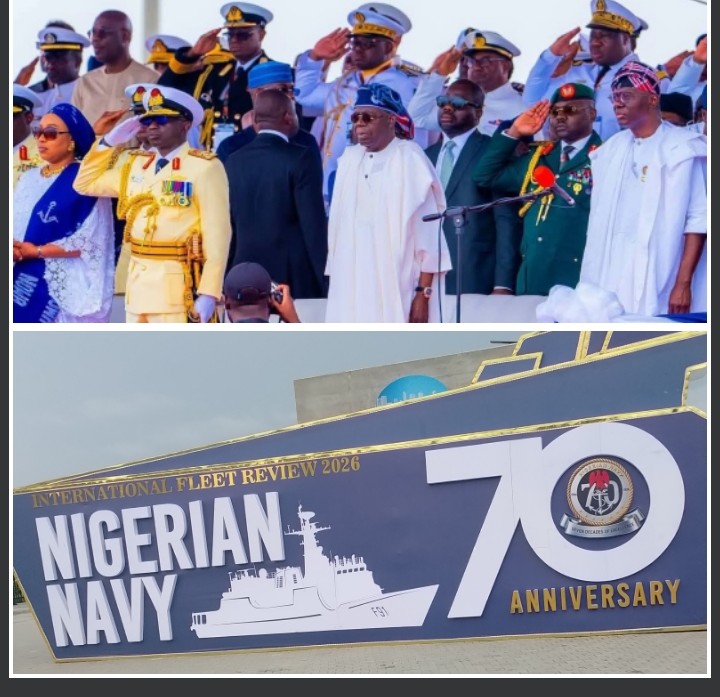
One of the major highlights of the anniversary celebrations was the International Fleet Review held on Monday, June 1, 2026, in Lagos.
President Bola Ahmed Tinubu presided over the event, which brought together naval ships from Nigeria and participating foreign countries in a display of maritime capability, professionalism, and international cooperation.
The review underscored the Nigerian Navy’s growing role as a leading maritime force in the Gulf of Guinea and highlighted the importance of collaboration in securing regional waters against piracy, sea robbery, illegal fishing, and other maritime crimes.
The event featured an aerial combat display, a fleet sail-past and a showcase of Nigerian and foreign naval assets, highlighting international maritime cooperation and naval capability.
While speaking, President Tinubu praised the Nigerian Navy for eradicating piracy in Nigerian waters and significantly reducing crude oil theft and other maritime crimes, just as he noted that improved surveillance systems, rapid response mechanisms and enforcement operations had strengthened maritime security, supported increased oil production and contributed to economic growth.
The President also described the Nigerian Navy as the most formidable naval force in Africa, commending its transformation from a colonial marine force into a modern and sophisticated naval service.
In turn, the Chief of Naval Staff, Vice Admiral Idi Abbas, highlighted the Nigerian Navy’s growing collaboration with navies around the world, noting that sustained international cooperation has contributed to maintaining the Gulf of Guinea’s zero-piracy status and advancing collective maritime security objectives.
The CNS further underscored the Navy’s increasing adoption of modern technologies, including unmanned aerial vehicles and artificial intelligence. According to him, these innovations have significantly improved the service’s ability to detect and respond rapidly to security threats within Nigeria’s maritime domain.
At the event were Lagos State Governor, Mr. Babajide Sanwo-Olu; Chairman, Senate Committee on Navy, Senator Gbenga Daniel, who represented Senate President Godswill Akpabio; Minister of Defence, Mohammed Badaru Abubakar; National Security Adviser (NSA), Mallam Nuhu Ribadu; Chief of Defence Staff (CDS), General Christopher Musa; Chief of Army Staff (COAS), Lieutenant General Olufemi Oluyede; Chief of Air Staff (CAS), Air Marshal Hassan Abubakar; Inspector General of Police (IGP), Kayode Egbetokun; Nigeria’s Ambassador to the Philippines, Vice Admiral Ibok-Ete Ibas; and former Chief of the Naval Staff (CNS), Vice Admiral Awwal Gambo (rtd), among others.
Others included icons of the Navy, state governors, members of the Federal Executive Council, ambassadors, high commissioners, foreign heads of navies and coast guards, and captains of industry. The day ended with a gala night a the Eko Convention Centre
Reviewed Ships
To the admiring glare of guests and dignitaries, ships sailed out for review. Nigeria was represented by NNS OLOIBIRI, commanded by Commander E.L. Olayiwola; NNS MAMBILA, commanded by Captain A.O.C. Ehanmo; NNS GURARA, commanded by Captain U.F. Anthony; NNS CALABAR, with Lieutenant B.Y. Lawal serving as Officer in Charge; NNS OSUN, with Lieutenant Q.W. Ofor serving as Officer in Charge; NNS ANDONI, commanded by Commander S.D. Defwan; NNS CHALAWA, commanded by Commander J. Emmanuel; NNS ZUR, commanded by Commander N. Mohammed; NNS NGURU, commanded by Commander K. Oye; NNS SOKOTO, commanded by Commander U.A.F. Ephraim; NNS EKULU, commanded by Commander A.Y. Adesokan; and NNS ABA, commanded by Captain Y.A. Shelleng.
Other Nigerian vessels included NNS IKOGOSI, commanded by Commander S. Yakuby; NNS KARADUWA, commanded by Commander D.E. Onyemaeze; NNS OJI, commanded by Captain J.O. Okoroafor; NNS IBENO, commanded by Captain O.O. Izokpu; NNS SHERE, commanded by Commander C.M. Egwaikhide; NNS FARO, commanded by Captain B.O. Omotayo; NNS KANO, commanded by Captain A.E. Aderinto; NNS IKENNE, commanded by Captain J.O. Edegware; DB ABUJA, commanded by Captain U.F. Abdullahi; DB LAGOS, commanded by Commander A. Ahmadu; NNS CENTENARY, commanded by Commander N.E. Etuk; and NNS KADA, commanded by Captain A.I. Ejeh.
Ghana was represented by Ghana Navy Ship PRU, commanded by Lieutenant Commander Joshua Hughes Addison; Benin Republic Navy Ship PENDJARI, commanded by Lieutenant Commander Mathieu Codjo Zanmassou; Brazilian Navy Ship ARAGUARI, commanded by Commander Anselmo Azevedo da Silva; Cameroon Navy Ship LA SANAGA, commanded by Lieutenant Commander Kamche Franck Freddy; and Ivorian Patrol Vessel VAILLANCE, commanded by Lieutenant Commander Kouakou Djaiblond Dominique-Yohann.
Commissioning of Three New Ships
Another landmark event during the anniversary celebrations was the commissioning of three new ships — NNS Oloibiri, NNS Mambila and NNS Gurara — into the Nigerian Navy fleet. The addition of the platforms is expected to enhance the Navy’s operational reach, maritime surveillance capabilities, and ability to protect Nigeria’s vast maritime domain.
The commissioning further demonstrated the Federal Government’s commitment to strengthening naval capacity and ensuring the Navy remains adequately equipped to address emerging security challenges within the nation’s territorial waters and the wider Gulf of Guinea.
Training and Induction of Nigerian Navy Marines
At the fleet review, the CNS announced the training and induction of the inaugural batch of 328 Nigerian Navy Marines. The newly established elite force is expected to strengthen the Navy’s capacity to combat terrorism, enhance maritime security and address inland security challenges.
Gulf of Guinea Combined Maritime Task Force Operationalisation
The celebration also witnessed the operationalisation of the Gulf of Guinea Combined Maritime Task Force (CMTF-GoG), a major regional security initiative aimed at fostering collective maritime security among participating nations.
The pioneer member countries include Nigeria, Côte d’Ivoire, The Gambia, Ghana, Liberia, and Sierra Leone. Headquartered in Lagos, the task force is designed as a standing operational force that remains on constant readiness to respond to maritime security threats across the Gulf of Guinea.
Led by Nigerian Navy Commodore Mohammed Shettima, the launch of the CMTF-GoG marked a significant milestone in regional maritime cooperation and reflected a growing African-led approach to addressing maritime crime through a permanent collaborative framework. It also reinforced the Nigerian Navy’s leadership role in advancing maritime security initiatives within the region.
Seapower for Africa Symposium
From Tuesday, June 2 to Wednesday, June 3, 2026, naval chiefs, policymakers, technology experts, and dignitaries from across Africa and beyond converged on the Eko Convention Centre, Lagos, for the sixth edition of the Seapower for Africa Symposium (SPAS) 2026 to deliberate on maritime security and emerging technologies.
Themed “Leveraging Technology for Enhanced Maritime Security in Africa,” Bello Muhammed Matawalle, Minister of state for Defence, emphasised that navies remain critical to global trade and economic stability, noting that the transnational nature of maritime threats requires stronger partnerships among African nations and international stakeholders.
In turn, Vice Admiral Idi Abbas, described the symposium as an important forum that has, since 2004, fostered dialogue and cooperation among maritime stakeholders in advancing security across Africa’s waters. He noted that maritime challenges have become too complex for any single nation to tackle alone and called for stronger collaboration among navies, coast guards and law enforcement agencies in line with the African Integrated Maritime Strategy 2050.
The day also featured a technical session on “Innovative Surveillance Technologies for Improved Maritime Domain Awareness,” moderated by Vice Admiral El Ogalla (Rtd) of Nigeria, with three presentations from AVM OC Ubadike of Nigeria, who spoke on Unmanned Aerial System Technologies in Maritime Surveillance; Dr. Bolarinwa Balogun of Nigeria, who spoke on the Optimisation of Satellite Technology for Improved Maritime Situational Awareness; and Rear Admiral Patrick Hayden (Rtd) of the USA, who addressed “Artificial Intelligence and Integration of Big Data in Maritime Surveillance.”
The second strategy session focused on “Capacity Building in Emerging Technologies for Improved Maritime Security,” moderated by Vice Admiral DJ Ezeoba (Rtd) of Nigeria, with speakers including Vice Admiral Vinay Badhwar (Rtd) of India, who spoke on Training Designs for Skill Acquisition in Emerging Technology; Dr. Ian Ralby of the USA, who spoke on Partnerships with Technology Providers and Institutions; and Dr. Paul Adalikwu of MOWCA, who addressed Future Trends in Emerging Technology Capacity Building.
On day two, the third and final strategy session, themed “Strategies for Improved Emerging Technology Adoption in Maritime Security,” was moderated by former Nigerian Navy CNS, Vice Admiral AZ Gambo (Rtd), with speakers including Rear Admiral Said Zebakhe of Morocco, representing the CNS, presenting his paper on “Policy and Regulatory Development for Emerging Technology Integration in Maritime Security”; Vice Admiral Monde Lobese of South Africa, addressing “Collaboration and Stakeholder Engagement in Technology Adoption”; and Professor Aykut Olcer of Sweden, speaking on “Incentives for Innovation and Technology Adoption.”
Wrapping up the two-day SPAS with interaction and questions from participants, the symposium concluded with the presentation of the Symposium Declaration of Intents.
Heads of Navies Bilateral Talks
On both days of the symposium, heads of navies held bilateral talks, focusing on regional maritime security, intelligence sharing, and fleet modernisation in the Gulf of Guinea, with reaffirmed commitments to collective security frameworks, maritime domain awareness, and joint operations in the Gulf of Guinea.
THISDAY gathered that the bilateral dialogues were driven by the central SPAS 2026 theme with a strong emphasis on joint operations against piracy, illegal fishing, and crude oil theft.
In attendance were senior naval leadership, defence ministries, and global maritime security partners.
Exhibition
One of the side attractions of the SPAS was the presence of over 50 global and regional maritime and defence industry exhibitors.
Key exhibitors, sponsors, and participants who showcased their platforms, technologies, and services included Proforce Intelligence Systems Limited, RTCOM Defense, Mantrac, Falcon Eye, Israeli Shipyard, United Bank for Africa, Sifax Group, Zenith Bank, Nigerian Navy Holding, Nigerian Navy Cooperative, and the Nigerian Navy Hydrographic Unit, alongside others.
Other exhibitors showcased prototypes of platforms with indigenous defence capabilities, locally manufactured armoured vehicles, AI-driven surveillance and advanced mobility solutions, AI Integration Command Systems, Digital Command Systems, as well as Marine Mobility and Engine Technologies.
Ceremonial Sunset and Award Night
In line with tradition, the Nigerian Navy wound up activities marking its 70th Anniversary with a Ceremonial Sunset Parade and Award Night in Lagos, showcasing its professionalism and celebrating seven decades of service to the nation.
Held at the Naval Dockyard, Victoria Island, Lagos, the Ceremonial Sunset — one of the most revered traditions in naval history — featured the lowering of the naval ensign at sunset, a band march-off and military honours witnessed by dignitaries, military leaders, former Chiefs of Naval Staff, foreign naval representatives and captains of industry.
The event culminated in a Dinner and Award Night at the Eko Convention Centre, where the Minister of Defence, General Christopher Musa (Rtd), commended the Nigerian Navy for its contributions to maritime security, the protection of oil and gas assets, anti-piracy operations and support to internal security efforts, which he said has strengthened Nigeria’s blue economy and enhanced trade and investment opportunities.
Meanwhile, Vice Admiral Idi Abbas, congratulated 31 officers and ratings honoured across seven award categories, while highlighting the Navy’s role in creating a safer maritime environment, which has helped boost confidence in Nigeria’s maritime sector and contributed to increased maritime revenue.
Earlier, the Chief of Policy and Plans, Rear Admiral A.I. Olodude, said the awards recognised officers and ratings who distinguished themselves through gallantry, innovation and dedicated service.
Among those honoured were Commodores M.M. Braimah, A.O. Odejobi and Toju Vincent, who received the Long Flying Medal (Pilots) Award. Other recipients included Commodore E.R. Ekuma, Captain C.O. Obute and Seaman Fireman Alhassan, who sustained severe injuries while fighting insurgents during military operations.
The Navy also honoured widows of fallen personnel in recognition of the sacrifices made by their husbands in service to the nation.
Having marked its 70 years of service, the Nigerian Navy’s journey from the Colonial Marine Department to a formidable maritime force stands as a testament to resilience, professionalism and continuous transformation.
With sustained investments in personnel, platforms, infrastructure and technology, the service under Vice Admiral Abbas remains well positioned to strengthen maritime security, protect Nigeria’s vast blue economy and project stability across the Gulf of Guinea and beyond in the years ahead.
[ad_2]
Source link











Leave a comment