




[ad_1]
Lagos traffic is a slow-motion public health disaster, contends K. BOLANLE ATI-JOHN
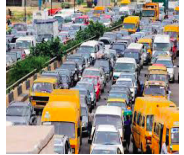
At 5:30 a.m. on a Tuesday, the Ikorodu Road is already a ribbon of brake lights. A man in a pressed shirt grips the wheel of a Toyota Camry, his face illuminated by the dashboard glow. He left home before his two children stirred. By the time he returns tonight, if the Third Mainland Bridge cooperates, they will be asleep. He will repeat this ritual tomorrow, and the day after, and every working day of his adult life. He is not commuting. He is being slowly poisoned.
For decades, Lagosians have described their daily ordeal with a word that sounds almost gentle: “go slow.” It evokes inconvenience, delay, frustration. But what if that language is not merely inadequate, what if it is actively concealing a crisis of far greater magnitude?
Let us be direct: Lagos traffic is no longer merely a mobility problem. It is a public health and citizen safety emergency disguised as urban congestion. It is a daily stress system imposed on millions of people, converting time, air, attention, energy, and safety into hidden public costs. Every hour spent trapped in gridlock is an hour of exposure to toxic air, elevated blood pressure, road danger, insecurity, and lost productivity. A city that cannot move its people safely cannot fully protect their health, dignity, or economic potential.
In 2020, the World Bank published a study that should have stopped Lagos in its tracks. The study estimated that ambient air pollution caused about 11,200 premature deaths in Lagos in 2018, the highest toll of any city in West Africa. It also estimated the economic cost of those deaths and associated illness at $2.1 billion, roughly 2.1% of Lagos State’s GDP. Children under five accounted for 60% of the fatalities.
The primary culprit, the study found, was road transport. On an average day, 227 vehicles clog every kilometer of road in Lagos. Most are over 15 years old, running on fuel with sulfur levels 200 times higher than U.S. diesel standards. The study recorded Lagos’ ambient PM2.5 concentration at about 68 μg/m³. PM2.5 is the fine particulate matter capable of passing deep into the lungs and entering the bloodstream. Against the World Health Organization’s updated annual guideline of 5 μg/m³, that figure places Lagos in a dangerous zone of prolonged exposure.
What does this mean for the man on Ikorodu Road? After three hours of inhaling exhaust fumes, his respiratory system is under assault. Repeat this daily for years, and the epidemiological ledger fills with asthma, bronchitis, chronic obstructive pulmonary disease, and lung cancer. But the damage does not stop at the lungs. Prolonged exposure to traffic related noise pollution, the ceaseless honking, the revving engines, the generator hum from roadside stalls, elevates cortisol levels, contributing to hypertension, anxiety disorders, and sleep disruption. The driver sitting motionless for hours is accumulating metabolic strain, back injury, and cardiovascular risk that no weekend exercise can reverse.
This is not conjecture. This is clinical reality dressed in the casual language of “go slow.”
If the health argument does not compel action, the economic arithmetic should terrify. According to the Danne Institute for Research’s Connectivity and Productivity study, traffic congestion costs Lagos an estimated ₦3.83 trillion annually, often rounded up in public discussion to about ₦4 trillion. The study also estimated that Lagos loses about 14.12 million productive hours daily to congestion. Depending on the GDP benchmark used, that annual loss is equivalent to several percentage points of Nigeria’s economic output, leaking from a single city.
The average commuter spends 2.21 hours in transit each day. Car owners pay an estimated additional ₦133,978 annually in fuel costs attributable to congestion; public transport users, ₦79,039.
But these aggregate figures, staggering as they are, fail to capture the granular cruelty of the loss. It is the tailor in Surulere who cannot guarantee delivery times and loses contracts to competitors in less gridlocked cities. It is the pharmaceutical distributor whose refrigerated van idles for hours in Apapa while temperature sensitive vaccines degrade. It is the secondary school student who arrives for exams already mentally depleted. Lagos traffic does not merely waste time; it systematically destroys value across every sector of the economy.
And then there is the shadow economy that traffic itself has spawned. Some investigative and media estimates suggest that the informal street level levy and extortion system associated with transport union actors, known locally as “agberos,” extracts hundreds of millions of naira daily from commercial drivers. Even allowing for uncertainty in the figures, the scale is large enough to constitute a parallel mobility tax on the urban poor and working class. This is money collected in cash, unreceipted, unaudited, unaccounted for, a parallel taxation regime that raises the cost of mobility for millions while insulating the political class from accountability.
This is not petty corruption. It is a structural feature of Lagos’ political economy: transport unions have evolved over decades into formidable grassroots networks capable of voter mobilization and territorial enforcement. Over time, the relationship between transport union power, local political mobilization, and weak enforcement has created a perception of operational impunity. The result is a system in which the very actors who should be partners in traffic discipline are instead extractive rentiers who profit from disorder.
Traffic congestion does not merely harm through pollution and stress; it kills directly through the degradation of emergency response. Lagos is a city where a medical emergency can become a fatality because the victim, the ambulance, the doctor, or the blood supply cannot move fast enough. There are no protected emergency corridors. The concept of yielding to a siren exists only in theory.
The Lagos State Emergency Management Agency recorded 1,305 road traffic accidents between January 2023 and March 2024 alone. But this figure captures only reported crashes. It does not quantify the likely cases of the heart attack victim who dies in an ambulance stalled behind a fuel tanker. It does not measure the stroke patient for whom the golden hour expires somewhere between Mile 2 and Orile. It does not account for the pregnant woman in labour whose taxi is pinned between two danfos on the Third Mainland Bridge.
The link between traffic and violent crime deserves equal scrutiny. Gridlocked vehicles at night become stationary targets for robbery, carjacking, and opportunistic assault. Broken down trucks on dark corridors create choke points where predators operate with near impunity. The city’s congestion is not merely an inconvenience for law enforcement; it is an active enabler of criminality.
Lagos possesses one of Africa’s most sophisticated transport planning frameworks, the Lagos Strategic Transport Master Plan, prepared with the Japan International Cooperation Agency. The Lagos Metropolitan Area Transport Authority, LAMATA, has articulated a vision of integrated mass transit encompassing rail, regulated buses, ferries, and non motorized transport. In 2012, the state enacted a road traffic law that was, at the time, among the most ambitious regulatory interventions in the region.
Yet the gap between plan and pavement remains vast. The Blue Line Rail is an important milestone. Lagos State officials recently reported that it carried about 3.5 million passengers in 2025, with daily ridership rising to about 15,000 commuters. That is progress, but still modest when measured against Lagos’ vast daily commuter demand. The Bus Rapid Transit network covers barely 15% of commuter routes. The Quality Bus Corridor projects announced with fanfare have been plagued by slow implementation and missed deadlines. Meanwhile, high rise residential estates continue to sprout along narrow feeder roads designed for the population of the 1980s, with no mandatory traffic impact assessments.
LASTMA remains trapped in a largely reactive posture, firefighting gridlocks at known choke points rather than leading a fully technology enabled system of lane discipline, incident response, and traffic flow optimization. The 2012 Road Traffic Law produced a measurable decline in motorcyclist fatalities, demonstrating that regulation backed by enforcement works. But enforcement has been inconsistent, and political pressure from transport unions has repeatedly blunted reform efforts.
Lagos is not the first megacity to confront a mobility crisis, and the global record offers both inspiration and caution. London’s congestion charge, introduced in 2003, produced a 30% reduction in congestion within the charging zone and a 15% reduction in circulating traffic in its first year. Bogotá’s TransMilenio Bus Rapid Transit system demonstrated that a developing world city could deploy high capacity transit at a fraction of rail costs, moving over 2 million passengers daily. Jakarta’s odd even license plate rationing policy produced a statistically significant reduction in travel time, though the gains were modest, about 3%, underscoring that demand management alone cannot substitute for systemic investment.
The consistent lesson is this: cities that have meaningfully reduced congestion did not do so through a single intervention. They combined mass transit expansion, demand pricing, technology backed enforcement, and land use reform into an integrated doctrine. Critically, they also confronted the political economy of their transport sectors. They recognized that reform fails when the institutions charged with implementation are captured by the same interests that profit from the status quo.
The central argument is simple: Lagos must stop treating traffic as a transport inconvenience and start treating it as a life protection imperative. Every policy reform that reduces congestion also reduces disease exposure, accident risk, insecurity, stress, wasted time, and preventable death. This reframing is not semantic. It changes the urgency, the institutional architecture, and the metrics of success.
What might a Health and Safety Transport Doctrine for Lagos include?
First, mass transit at scale. Lagos needs a far larger fleet of high capacity buses, faster rail expansion, and better integration between bus, rail, ferry, and last mile transport.
Second, technology backed, corruption resistant enforcement. Traffic cameras, automatic number plate recognition, and digital ticketing can reduce the discretion that fuels extortion. When fines are predictable and automated, the roadside bribe becomes harder to negotiate.
Third, dedicated freight corridors and port logistics reform. The Apapa gridlock, driven by tankers and container trucks, cannot be solved by traffic officers alone. It requires holding bays, night logistics, and scheduling protocols coordinated with the port authority.
Fourth, air quality monitoring and public reporting. Pollution sensors along major corridors would make visible what is currently invisible: the true toxicity of the air Lagosians breathe. What is measured can be managed.
Fifth, emergency mobility protection. Ambulances, fire trucks, and security vehicles require protected corridors, enforceable priority rules, and public education on yielding to emergency vehicles.
Sixth, land use reform. No major residential, commercial, or industrial development should receive approval without a traffic impact assessment that accounts for existing road capacity. The era of building first and asking questions later must end.
Seventh, citizen safety design: lighting, CCTV coverage, pedestrian bridges, secure bus shelters, and safe last mile options for the millions who walk significant distances daily.
Lagos traffic is not merely “go slow.” It is slow violence against the body, the family, the economy, and the civic promise of the city. The first step toward remedy is truth. We must stop calling it inconvenience. We must call it what it has become: a public health emergency, a safety crisis, and a daily tax on human dignity.
Rear Admiral Ati-John (rtd) fdc⁺ is a Distinguished Fellow of the National Defence College, Abuja, and writes from Lagos
[ad_2]
Source link










Leave a comment